Aeration Equipment: A Comprehensive Analysis of Core Equipment in Wastewater Treatment Aeration Systems
By: Kate Nana
Post Date:June 10, 2026
Post Tags:Aeration Equipment: A Comprehensive Analysis of Core Equipment in Wastewater Treatment Aeration Systems
Introduction: The Core Role of Aeration in Wastewater Treatment
In the biochemical treatment phase of wastewater treatment, the aeration system serves as the "heart" that guarantees process efficiency. By performing two core functions—supplying oxygen to the water body and driving agitation and mixing—it provides the dissolved oxygen essential for the survival of aerobic microorganisms. Concurrently, it ensures full contact between the microorganisms and the pollutants in the wastewater, significantly enhancing biochemical reaction efficiency. This makes it a critical determinant of overall wastewater treatment outcomes.
As global demand for water environment governance continues to escalate, the market for wastewater treatment aeration equipment is maintaining steady growth. Varying regional requirements for treatment efficiency, energy consumption control, and operational and maintenance (O&M) costs are driving continuous iterations and upgrades in aeration technology. This article delivers a comprehensive analysis encompassing the definition, classification, core equipment, and application scenarios of "aeration equipment," providing a reliable reference for equipment selection and system deployment in wastewater treatment projects.
Core Definition of Aeration Equipment
Aeration equipment refers to the general term for specialized machinery used in wastewater treatment to actively introduce air (or oxygen) into wastewater and achieve fluid agitation and mixing.
Its core functionalities focus on two primary dimensions:
-Oxygenation Function: Distributes air into the water body through various technical methods to increase Dissolved Oxygen (DO) levels. This satisfies the oxygen consumption needs of aerobic microorganisms and guarantees their efficiency in decomposing organic matter.
-Agitation Function: Drives fluid movement to prevent the settling of activated sludge. It maintains a uniform mixture of sludge and wastewater, allowing microorganisms to come into full contact with pollutants, thereby enhancing the stability of the biochemical treatment.
The performance of aeration equipment directly dictates the oxygen utilization rate, energy consumption levels, and treatment efficacy of the biochemical tank, making it an irreplaceable core component of wastewater treatment systems.
Core Classification of Aeration Equipment
Aeration equipment can be categorized in multiple ways based on its working principle and installation structure. Different types are tailored to specific process scenarios and water quality characteristics. The following are the mainstream classifications and feature analyses used across the industry:
1. Classification by Working Principle

2. Classification by Installation Structure
-Retrievable Aeration Systems: Typified by systems like the REHAU (RAUBIOFLEX) retrievable aeration system, individual aeration units can be lifted directly out of the tank using a surface hoisting device. This allows maintenance and overhauls to be performed without draining the tank, vastly reducing O&M costs and downtime. This structure is ideal for large municipal wastewater treatment plants (WWTPs) and projects where modification is difficult, making it the mainstream choice for high-O&M demand scenarios.
-Fixed Aeration Systems: Diffusers are fixed to the bottom of the tank via brackets, utilizing a fixed layout for both piping and equipment. This classic solution for traditional large-scale wastewater treatment projects offers high oxygen utilization and stable operation. However, maintenance requires draining the tank, leading to higher O&M costs, making it more suitable for newly built projects with favorable maintenance conditions.
In-Depth Look at Core Equipment
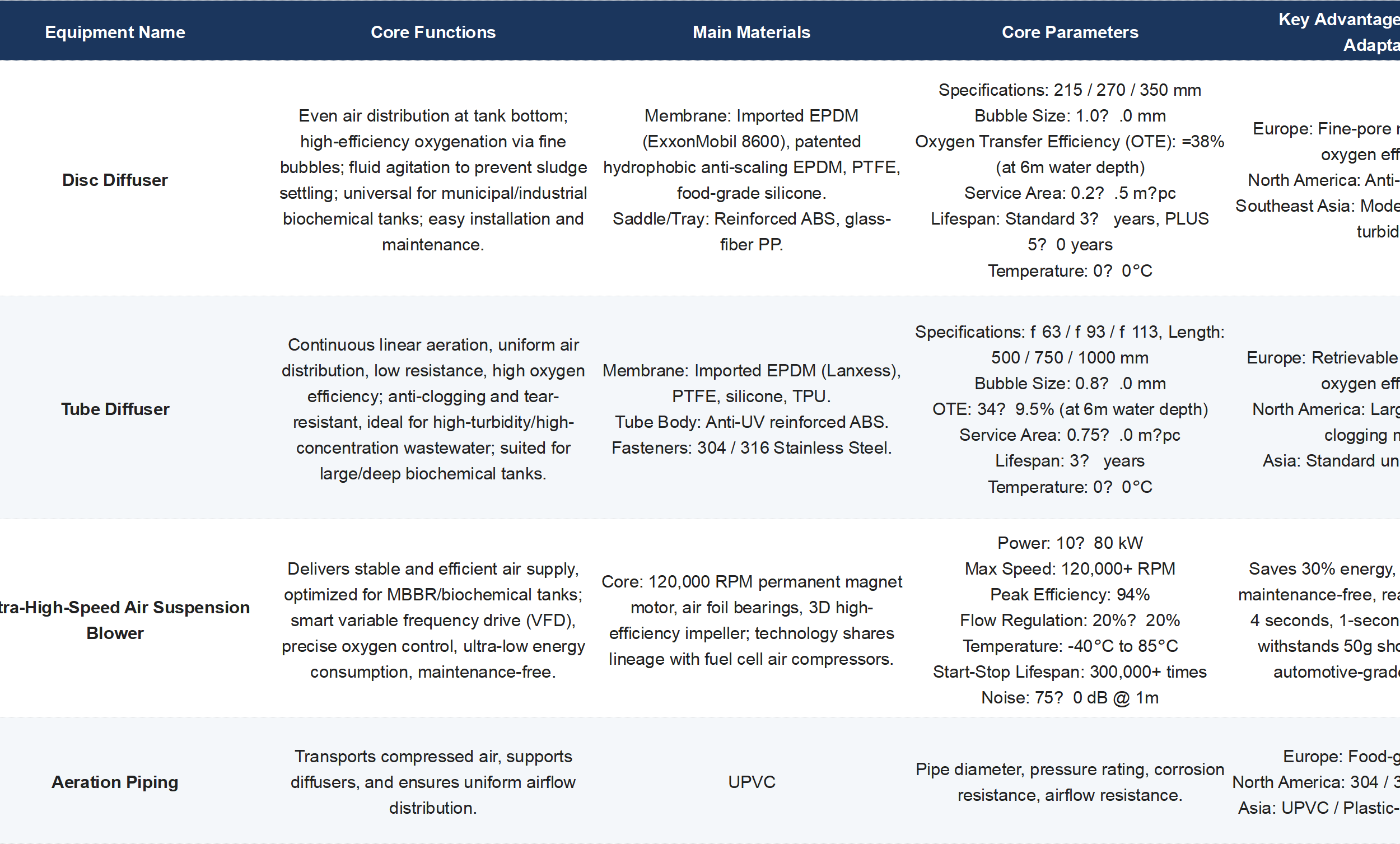
A complete aeration system consists of three core components: diffusers/aerators, blowers, and aeration piping. The functions, materials, and parameters of each part directly determine overall system performance.
Application Matching: Choosing the Right Aeration Equipment
Wastewater treatment scenarios vary significantly in water quality, treatment scale, and O&M conditions. Equipment selection must be targeted to balance treatment outcomes with cost control.
1. Municipal Wastewater Treatment
Municipal wastewater is characterized by large volumes and relatively stable water quality. The core requirements are low energy consumption, high oxygen utilization, and long-term stable operation. The mainstream choice is diffused aeration combined with fine-pore diffusers (such as disc or tube diffusers), powered by high-efficiency centrifugal blowers. Priority is given to retrievable structures to lower long-term O&M costs.
2. Industrial Wastewater Treatment
Industrial wastewater features massive variations in water quality (e.g., chemical or printing and dyeing wastewater). Certain streams contain high-concentration pollutants or corrosive components, demanding superior corrosion and clogging resistance from aeration equipment. Jet aerators, corrosion-resistant silicone diffusers, or anti-clogging aeration systems can be deployed, while piping and blower materials must be selected based on the wastewater's pH levels.
3. Decentralized and Small-Scale Wastewater Treatment
Decentralized projects like rural wastewater or small enterprise effluents feature small scales and limited O&M conditions. The core needs are simple installation, easy maintenance, and low energy consumption. Submersible aerators and small surface aerators are the preferred options here, as they eliminate the need for complex piping at the bottom of the tank, making deployment and upkeep hassle-free.
4. Regional Water Quality Adaptations
-High-Turbidity Wastewater in Southeast Asia: The high suspended solids (SS) content makes aeration equipment prone to clogging. Priority should be given to diffusers with excellent anti-clogging performance (such as coarse-pore silicone diffusers or jet aerators) to prevent drops in oxygen utilization caused by micro-pore blockage.
-Low-Concentration Wastewater in Europe: The low concentration of organic matter demands strict control over oxygen efficiency and energy use. The mainstream choice is high-efficiency fine-pore aeration systems paired with energy-saving blowers to minimize operational costs.
Global Application Status: Regional Technical Preferences
The implementation of aeration equipment is closely tied to local water quality characteristics, environmental standards, and O&M habits, leading to distinct regional preferences:
-Europe: Driven by stringent environmental standards, Europe places a high premium on energy consumption and O&M cost control. High-efficiency, retrievable fine-pore aeration systems combined with efficient centrifugal blowers dominate the market. Materials lean toward corrosion-resistant, long-life EPDM or silicone diffusers, with a heavy emphasis on energy-efficient system retrofits.
-North America: This region prioritizes system stability and risk mitigation. Tube diffusers and jet aerators hold a significant market share, and blowers tend to be heavy-duty, highly reliable centrifugal units to support the long-term stable operation of large municipal WWTPs.
-Asia: Market demands are highly diversified. Large-scale municipal projects primarily rely on diffused fine-pore aeration systems, whereas small-to-medium projects widely adopt submersible aerators and Roots blowers. Concurrently, with tightening environmental standards, the adoption rate of energy-saving aeration equipment is steadily rising.
Conclusion: Core Value and Selection Direction
As the heart of the biological treatment system, the core value of aeration equipment lies in providing a stable dissolved oxygen supply at a reasonable energy cost while driving down O&M expenses. It is the critical pillar ensuring efficient and stable wastewater plant operations.
In actual project selection, engineers must comprehensively evaluate the treatment scale, water quality characteristics, regional environment, and O&M conditions to choose the most suitable equipment type and configuration. For project-specific equipment selection, system optimization, or technical consultation, feel free to contact the professional team at Aquasust for customized aeration solutions to achieve highly efficient, low-consumption water environment governance goals.