Aeration Pipe Selection for Bottom-Fixed Diffuser Systems: Materials, Sizes & Engineering Guide
Aeration Pipe Selection for Bottom-Fixed Diffuser Systems: Materials, Sizes & Engineering Guide
Category: Field Questions & Expert Answers
Published: June 27, 2026
Tags: fine bubble diffuser, tube diffuser, disc diffuser, aeration pipe sizing, UPVC aeration pipe, bottom-fixed aeration system, wastewater treatment aeration
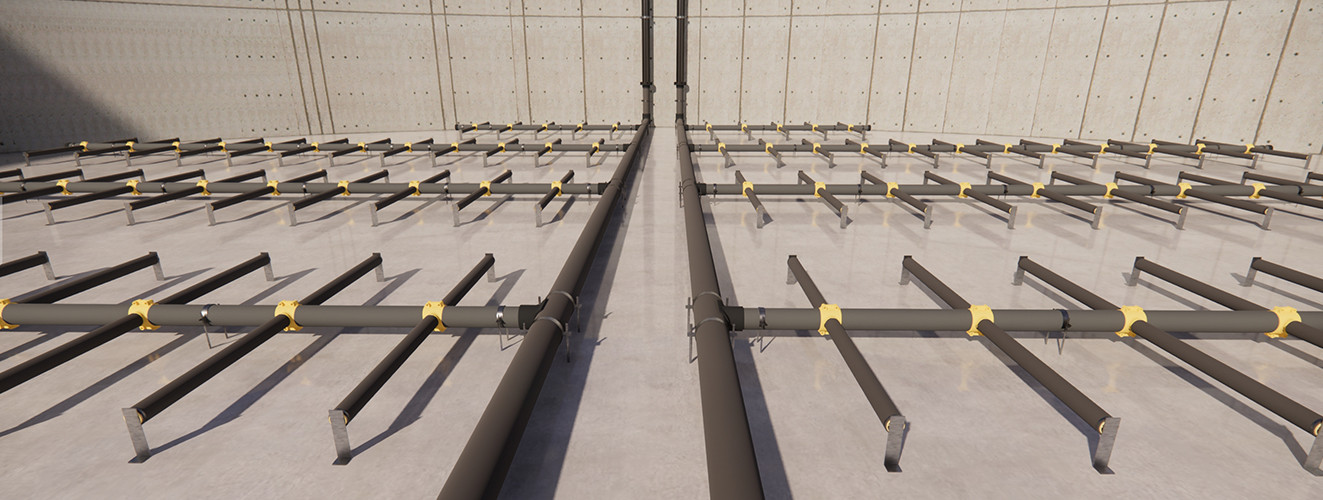
Q: In a bottom-fixed fine bubble aeration system, what pipe materials and standard sizes are used for the main header pipe and lateral pipes — and how do engineers select the right specification?
This is one of the most frequently asked questions from our project partners during commissioning and tender preparation. Getting the pipe specification right is critical: undersized pipes increase energy costs; oversized pipes create buoyancy problems that destabilize the entire aeration grid. Below is AquaSust's field-tested selection guide.
Part 1 — Common Pipe Materials for Bottom-Fixed Aeration Systems
For aerobic tank aeration systems using fine bubble tube diffusers or disc diffusers, the two dominant pipe materials are:
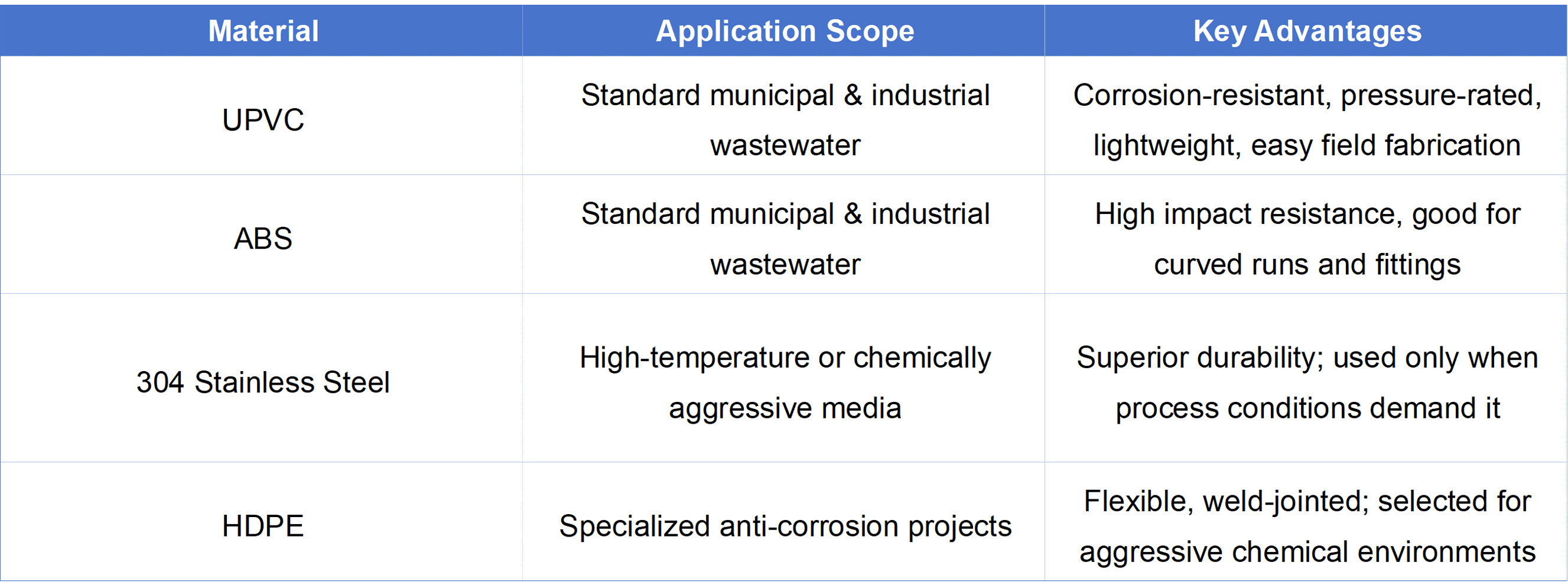
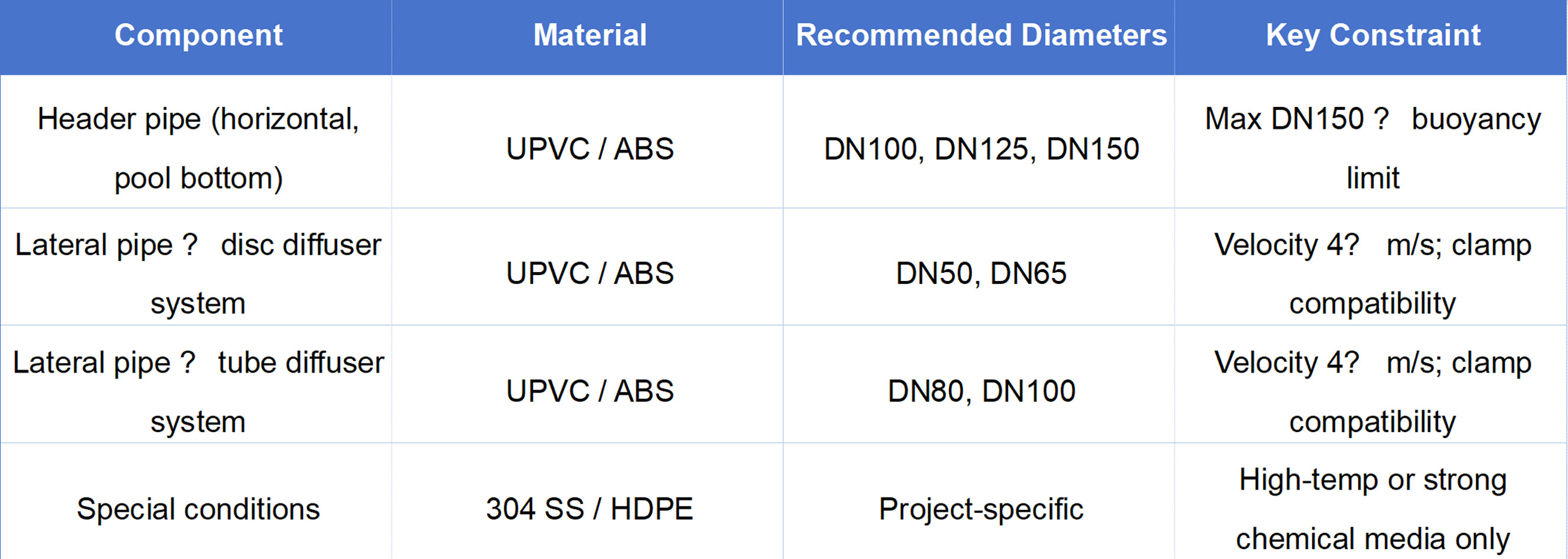
Practical note: In the vast majority of aerobic activated-sludge basins — including MBR tanks, oxidation ditches, and SBR reactors — UPVC or ABS pipe is the standard choice. Stainless steel and HDPE are specified only for exceptional process conditions such as high-temperature digesters or industrial effluents with strong chemical loads.
Part 2 — Standard Pipe Diameter Ranges
2.1 Main Header Pipe (Pool Bottom Manifold)
The main header pipe distributes compressed air from the blower riser to the lateral grid. For bottom-fixed fine bubble aeration systems:
●Maximum diameter: DN200
●Commonly specified diameters: DN100 / DN125 / DN150
●Why not DN200 for horizontal runs?
When air flows through a large-diameter submerged pipe, the buoyancy force acting on the pipe increases significantly. At DN200, the upward lift force exceeds what standard bottom-fixed mounting brackets can resist. The result over time is pipe displacement, bracket fatigue, and system misalignment. Even adding extra brackets provides only marginal improvement — it cannot guarantee long-term stable operation. AquaSust recommends keeping the horizontal header at DN150 or smaller.
Design tip: If the wall riser is DN200, install a reducer fitting at the riser base to transition down to DN150 before the header enters the horizontal run.
2.2 Lateral Pipes (Diffuser Supply Lines)
Lateral pipes connect the header to the individual diffuser assemblies. Available sizes and typical usage:
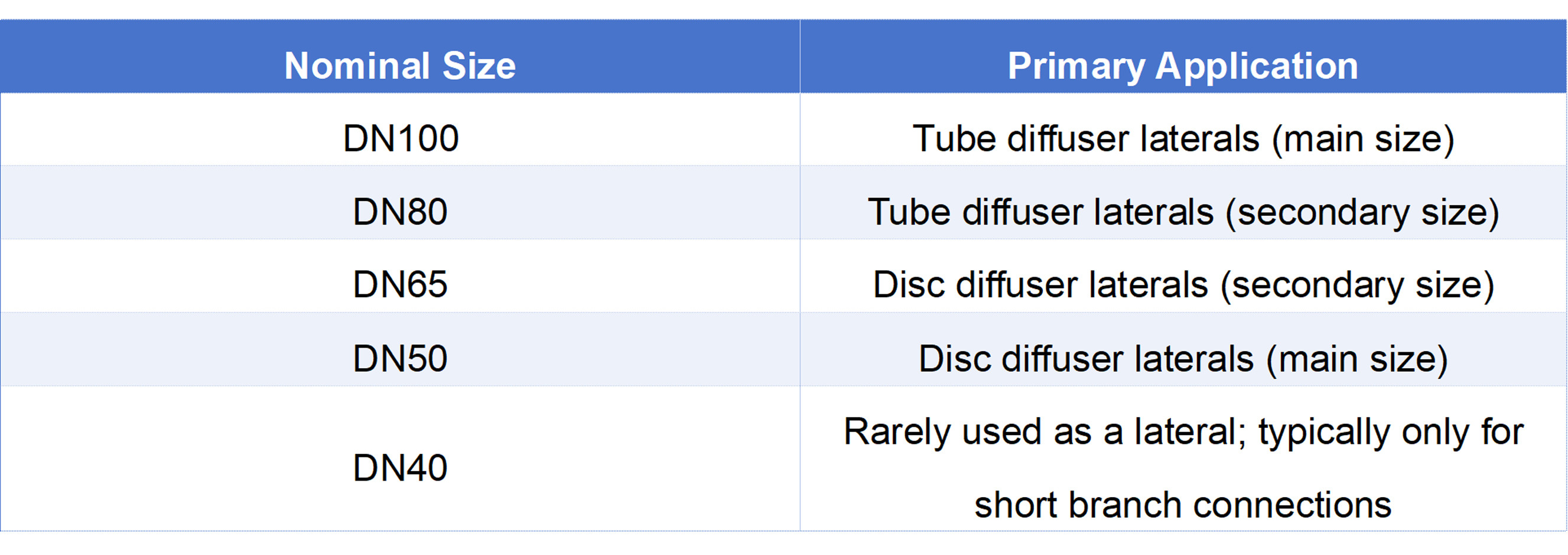
Rule of thumb:
Disc diffuser systems
●→ DN50 or DN65 laterals
Tube diffuser systems
●→ DN80 or DN100 laterals
Part 3 — Engineering Rationale Behind the Selection Criteria
3.1 Why Material Matters
UPVC and ABS provide the right balance of corrosion resistance, pressure rating, and cost for standard wastewater aeration. Both are compatible with standard solvent-cement fittings and clamp connectors used to attach disc or tube diffuser assemblies. Switching to stainless steel or HDPE increases material and fabrication costs significantly and is only justified when the process medium requires it.
3.2 Why Header Pipe Diameter Is Capped at DN150
Two factors drive this limit:
1. Operating pressure integrity: The header carries the full volumetric airflow from the blower at relatively high static pressure. An undersized header creates excessive pressure drop and uneven air distribution across the diffuser grid. An oversized header — while reducing pressure drop — generates severe buoyancy forces on the submerged pipe that standard mounting hardware cannot contain.
2. Long-term structural stability: Buoyancy-induced stress on mounting brackets causes cumulative fatigue. Even with additional brackets, DN200 horizontal headers in bottom-fixed configurations have a documented history of pipe migration and bracket failure. Keeping the header at DN150 or below is AquaSust's standard design practice based on field performance data.
3.3 Why Lateral Diameter Is Selected by Diffuser Type
The lateral pipe diameter controls the air velocity inside the pipe — a critical parameter for diffuser performance and system longevity. AquaSust's design standard targets an airflow velocity of 4–8 m/s inside lateral pipes for four reasons:
1. Optimal flow velocity: Within 4–8 m/s, pipe friction losses are moderate, air distribution between diffusers is balanced, and no significant vibration or noise occurs in the piping system.
2. Even air distribution across the diffuser grid: Correct lateral sizing balances the static pressure at the inlet of each diffuser along the lateral run. If velocity is too low (oversized pipe), pressure imbalances cause uneven bubble output; if too high (undersized pipe), head losses increase blower energy consumption.
3. Standard clamp compatibility:
●DN50 / DN65 → matches the standard saddle clamps used for
disc diffuser
saddle connections
●DN80 / DN100 → matches the standard saddle clamps used for
tube diffuser
saddle connections
Using the correct diameter ensures field installation with standard hardware — no custom machining required.
4. Lowest total cost of ownership: An optimized lateral diameter minimizes both blower energy consumption (lower friction losses vs. undersized pipe) and material cost (lower weight and fitting cost vs. oversized pipe). The combined lifecycle cost is lowest when velocity is kept in the 4–8 m/s target band.
---------------------------------------------------------------------------------------------------------------------------------------------------
Quick Reference: Pipe Selection Summary
Related Products
AquaSust Tube Diffusers
●— Fine bubble tube diffuser assemblies for high-efficiency oxygen transfer
AquaSust Disc Diffusers
●— Membrane disc diffusers for municipal and industrial wastewater
AquaSust Aeration Systems
●— Complete bottom-fixed and suspended aeration system solutions
About This FAQ Series
Every week, AquaSust's field engineers encounter real questions from project designers, contractors, and plant operators. This FAQ series captures those questions — along with AquaSust's engineering answers — to help the wider wastewater treatment community design better aeration systems.
Have a question about your project? Contact our engineering team.
AquaSust — Fine Bubble Aeration Specialists | www.aquasust.com