How to Choose Tube Diffuser Installation for Easy Maintenance: 3 Types Compared
How to Choose Tube Diffuser Installation for Easy Maintenance: 3 Types Compared
By: Kate Nana
Post Date: July 13th, 2026
Email:Kate@aquasust.com
Post Tags:Tube Diffuser Installation Types · Retrievable Aeration System · Zero Downtime Maintenance · Wastewater Treatment OPEX · Bottom-Mounted vs Retrievable
TL;DR
Fully retrievable aeration systems deliver the lowest long-term maintenance burden because the entire assembly lifts out without tank drainage. Retrievable module (4/6-tube) systems offer a cost-balanced middle ground — modular flange removal means zero downtime for servicing. Bottom-mounted aeration carries the lowest upfront cost but demands full tank drainage, creating significant operational disruption every service cycle. Choose based on your acceptable downtime tolerance, tank age, and 5-year total cost of ownership.
Why Maintenance-Friendliness Is the Critical Selection Factor
Aeration is the single largest energy consumer in a wastewater treatment plant (WWTP), accounting for 50–70% of total plant OPEX (industry benchmark, aligned with data in Metcalf & Eddy: Wastewater Engineering, 6th ed.). Yet energy cost is only half the equation. The hidden cost multiplier is maintenance downtime.
When a conventional bottom-mounted diffuser system requires servicing, operators face a cascade of forced actions: shut down the aeration zone, drain the tank, coordinate confined-space entry permits, remove accumulated sludge, perform the repair, refill, and re-stabilize the biological process. For a 100,000 m³/d municipal WWTP, a single scheduled maintenance event can consume 10–15 days of partial or full process interruption — representing a disproportionate share of annual operating budget in labour, bypass costs, and process recovery time.
The U.S. EPA's Fine Pore Aeration Design Manual (EPA/625/1-89/023) identifies diffuser fouling and cleaning frequency as primary lifecycle cost drivers, and recommends evaluating retrieval access as a key design criterion alongside oxygen transfer efficiency. Similarly, EN 12255-15 (European standard for wastewater treatment plants) mandates consideration of maintenance access during equipment selection.
This is precisely why the tube diffuser installation type — not just membrane material or SAOTE rating — determines the true economic performance of your aeration investment.
Alt: tube diffuser installation types comparison — bottom-mounted vs retrievable module vs fully retrievable
The 3 Main Tube Diffuser Installation Methods
Bottom-Mounted Aeration
Bottom-mounted aeration is the conventional approach: tube diffusers are fixed to a manifold framework bolted directly to the tank floor, with air supply piping routed along the base of the aeration basin. The diffusers remain permanently submerged.
Key parameters:
●Typical installation depth: 4–6 m
●Air distribution: fixed lateral headers
●Materials: PVC frame, EPDM or PTFE membrane tube diffusers
●First-time installation cost index: baseline (1.0×)
Operational reality: Because every component sits on the tank floor, any inspection, cleaning, or diffuser replacement requires full tank drainage. This process typically involves biological process shutdown, mechanical dewatering, confined-space entry under safety protocols, sediment removal, maintenance work, and a 5–15 day process re-stabilization period before returning to rated biological performance.
When to choose this: When budget for initial capital is the absolute constraint, the project is new construction, and operational planners have confirmed that scheduled drainage downtime can be absorbed without impact on permit compliance or bypass capacity.
Retrievable Module (4/6-Tube) Aeration
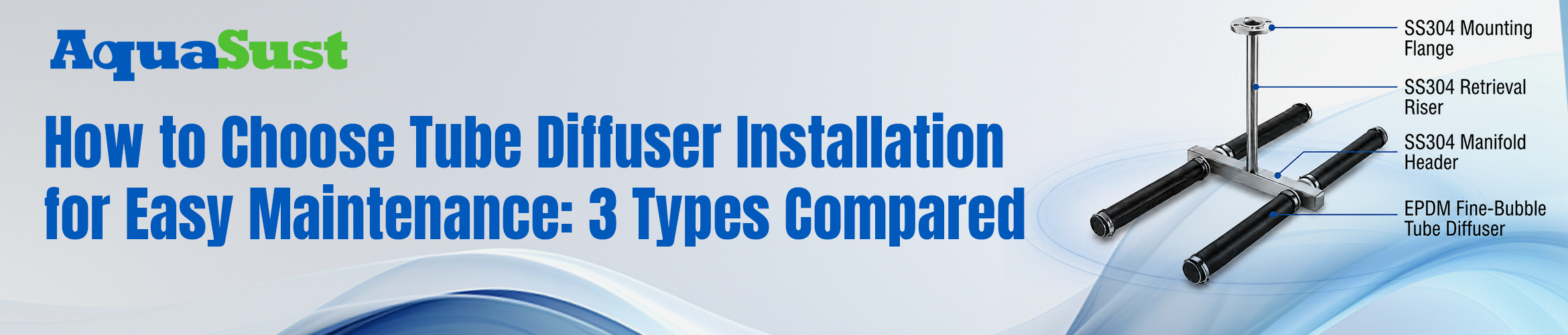
The retrievable module configuration relocates the structural air distribution logic above the liquid surface. Lateral pipes run horizontally across the tank at the water line level, with drop pipes descending to diffuser header assemblies at the tank floor. The entire diffuser sub-assembly connects to the lateral via a bolted flange — meaning it can be disconnected and pulled vertically to the tank surface or poolside without any tank drainage.
Key parameters:
●Structural frame: hot-dip galvanised steel + 304 stainless steel riser pipe options
●Module configuration: 4-tube or 6-tube assemblies per retrieval unit
●Air supply connection: modular flange, gasket-sealed
●First-time installation cost index: 1.4–1.8× versus bottom-mounted
●Long-term maintenance cost advantage: significant reduction per service event (industry benchmark: 60–75% reduction in per-event labour and downtime cost)
Operational reality: Maintenance technicians disconnect the flange at water level, lift the module using a portable davit arm or crane, perform diffuser cleaning or replacement on the poolside, and re-lower. No drainage, no confined-space permits for the maintenance action itself, no process disruption.
When to choose this: When operational continuity is a priority, retrofit projects where tank drainage is impractical, or facilities operating under strict effluent permit conditions that cannot tolerate process interruption.
ully Retrievable Aeration System
The fully retrievable aeration system integrates all distribution piping, headers, diffuser assemblies, and structural frame into a single monolithic module per aeration zone. The entire assembly is designed for crane-assisted vertical extraction as one unit — from tank floor to surface — without disassembly.
Key parameters:
●Module coverage: typically 50–300 m² of aeration zone per module
●Air distribution uniformity: engineered manifold geometry optimised for cross-section coverage (higher uniformity than split retrievable configurations)
●Frame material: hot-dip galvanised structural steel with 304 SS diffuser mounts
●First-time installation cost index: 2.0–2.8× versus bottom-mounted
●Maintenance retrieval time: typically 2–4 hours per module (lift-out to re-submersion)
Operational reality: The single-unit retrieval eliminates inter-component disassembly steps. Air distribution uniformity is engineered at the factory level rather than site-assembled, which reduces variance in oxygen transfer efficiency across the aeration zone. This is particularly valuable in large circular tanks or rectangular basins where consistent DO distribution directly affects nitrification performance.
When to choose this: New construction at scale where long-term operational budget optimization matters, facilities with high labour costs per maintenance event, or plants where biological process stability is a regulatory requirement.
Alt: fully retrievable aeration system crane extraction — zero downtime maintenance
Head-to-Head Comparison Table
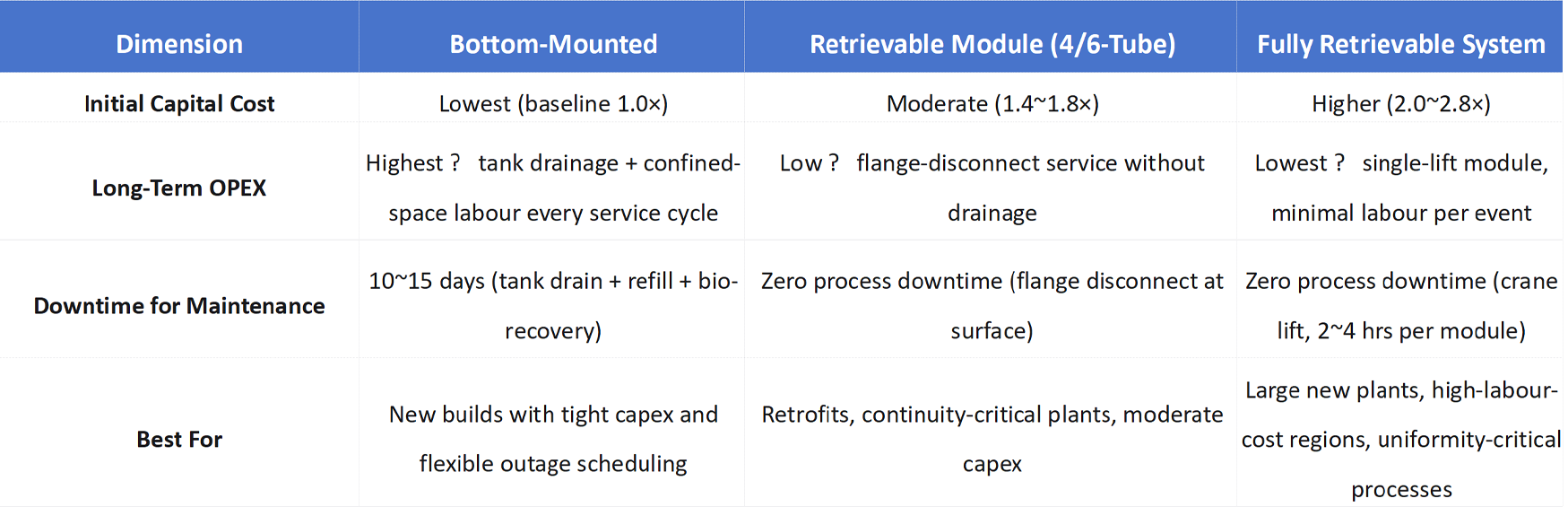
Note on TCO: Industry benchmarks indicate that for a facility operating for 15+ years, the total cost of ownership (capex + maintenance OPEX) of bottom-mounted systems frequently converges with or exceeds retrievable alternatives when accounting for downtime-related costs.
Field Experience — Which Do We Recommend?
In our engineering practice across 50+ countries, the decision framework follows three scenarios:
Scenario 1 — New municipal WWTP, process continuity is contractually required: Specify the fully retrievable aeration system. The upfront premium is typically recovered within 5–8 years through maintenance cost avoidance alone (industry benchmark range, varies by labour market). Biological process stability is preserved across all service events, which is particularly important for plants operating under ammonia effluent limits.
Scenario 2 — Retrofit of an existing plant where tank drainage would require bypass construction: Specify retrievable module (4/6-tube) configuration. This is the scenario where bottom-mounted alternatives simply cannot compete on a practical level — if bypass capacity does not exist, a drainage-dependent system creates a compliance risk that outweighs any capex savings.
Scenario 3 — Budget-constrained new build with confirmed outage flexibility: Bottom-mounted aeration is a rational choice, provided the project plan explicitly budgets for downtime costs over the asset's operational life and the facility has drainage infrastructure already in place.
Anonymous case reference: A large-scale municipal WWTP in East Asia retrofitted from bottom-mounted tube diffusers to a retrievable module system across six aeration lanes. The previous maintenance cycle required 15 days of tank drainage per lane per service event. Following the retrofit, maintenance events were reduced to zero-downtime flange-disconnect operations completed within a single shift. The project delivered a payback period within the range typical for such conversions (industry benchmark: 4–7 years for comparable municipal plants).
Alt: retrievable tube diffuser module flange connection — zero downtime aeration maintenance
Common Pitfalls & Misconceptions
Misconception 1: Bottom-Mounted Is Always the Cheapest Option
The upfront price of bottom-mounted diffuser systems is lower. However, when total cost of ownership is calculated across a 15–20 year asset life — incorporating scheduled drainage events, labour, confined-space compliance costs, biological process recovery, and potential permit exceedance risk — the TCO gap frequently narrows or reverses. Facilities that have performed honest lifecycle cost analyses consistently find that the "cheapest" option at procurement is not the cheapest option in operation.
Misconception 2: All Retrievable Systems Eliminate Tank Drainage
This is accurate only when the retrieval mechanism includes a 304 SS riser pipe connecting the submerged header to the above-water flange. Some lower-specification retrievable systems use PVC or uncoated steel risers that corrode, seize, or deform under load — making extraction mechanically impossible without drainage and cutting. Verify riser pipe material specification before procurement.
Misconception 3: Modular Systems Are More Complex to Operate
The opposite is true in practice. Modular retrievable systems move the complexity from the maintenance event (where errors have high consequences) to the factory (where quality is controlled). A plant operator performing a flange-disconnect lift operation faces fewer variables and risks than one coordinating a multi-day tank drainage, confined-space entry, and process restart sequence.
Alt: bottom aeration vs lifting boom aeration — maintenance process complexity comparison
Common Pitfalls & Misconceptions
Misconception 1: Bottom-Mounted Is Always the Cheapest Option
The upfront price of bottom-mounted diffuser systems is lower. However, when total cost of ownership is calculated across a 15–20 year asset life — incorporating scheduled drainage events, labour, confined-space compliance costs, biological process recovery, and potential permit exceedance risk — the TCO gap frequently narrows or reverses. Facilities that have performed honest lifecycle cost analyses consistently find that the "cheapest" option at procurement is not the cheapest option in operation.
Misconception 2: All Retrievable Systems Eliminate Tank Drainage
This is accurate only when the retrieval mechanism includes a 304 SS riser pipe connecting the submerged header to the above-water flange. Some lower-specification retrievable systems use PVC or uncoated steel risers that corrode, seize, or deform under load — making extraction mechanically impossible without drainage and cutting. Verify riser pipe material specification before procurement.
Misconception 3: Modular Systems Are More Complex to Operate
The opposite is true in practice. Modular retrievable systems move the complexity from the maintenance event (where errors have high consequences) to the factory (where quality is controlled). A plant operator performing a flange-disconnect lift operation faces fewer variables and risks than one coordinating a multi-day tank drainage, confined-space entry, and process restart sequence.
Alt: bottom aeration vs lifting boom aeration — maintenance process complexity comparison
Conclusion
The tube diffuser installation type you select today determines your plant's operational flexibility for the next 15–25 years. Bottom-mounted aeration remains a rational choice where capital budget is the binding constraint and planned outages are feasible. Retrievable module systems are the practical standard for retrofit applications and continuity-critical plants. Fully retrievable systems represent the lifecycle-optimised solution for new large-scale construction where long-term OPEX efficiency and biological process stability are priorities.
The engineering principle is consistent across all scenarios: maintenance access is not a secondary feature — it is a primary performance specification.
Ready to evaluate which installation type matches your plant's parameters?
Explore the AquaSust tube diffuser series for full technical specifications, or review the disc diffuser alternative for disc-based aeration configurations. For a complete overview of available aeration technologies, visit the aeration diffuser overview page.
To request an engineering consultation or quotation for your specific project, contact the AquaSust Engineering Team through aquasust.com.